

Evi Lambropoulou, the archaeologist who succeeded Petros Themelis, speaks to “Tharros”
“Continuing and completing the project at Ancient Messene is a major challenge.”
Since March 2024, the president of the Society for Messinian Archaeological Studies has been archaeologist Evi Lambropoulou, the woman who took on the difficult task of continuing Petros Themelis’s work after his death.
“Tharros” spoke with her about Ancient Messene, her collaboration with the late Petros Themelis, the guidelines he left behind, and the excavations set to begin in the very near future:
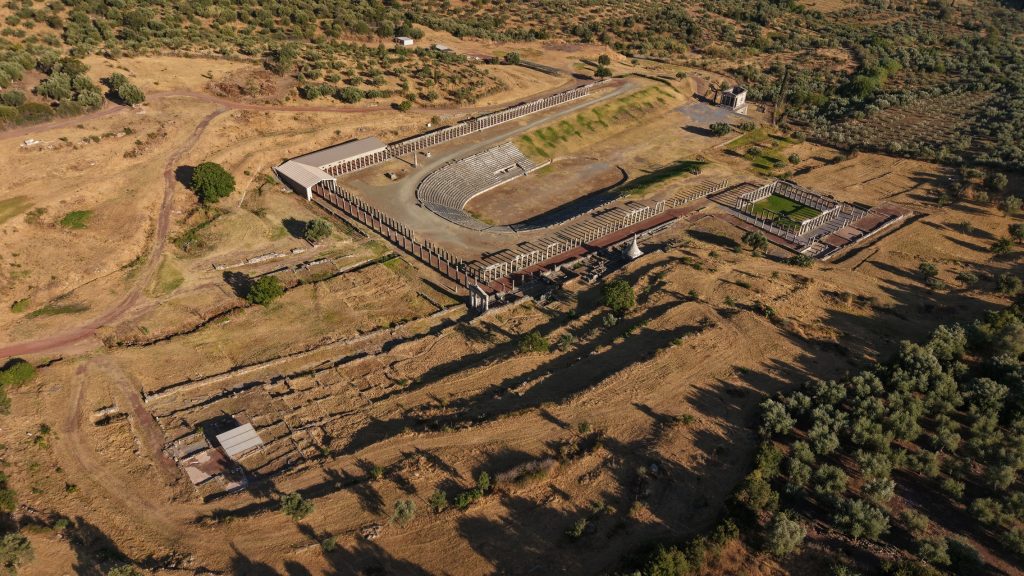
-Ancient Messene, what does this place mean to you?
For me, Ancient Messene is a place where I grew and matured—not only academically, but also on a deeply personal level, both as a scholar and as a person. For me, it was a “school” with high demands and standards, a place that constantly challenged you to test your strengths and endurance, yet at the same time held you in its embrace in a way that was almost magically addictive.
Ancient Messene today, looking back and having spent a very large part of my adult life working in and for it, closely connected not only to the monuments and the site, but also to the people, the living spirit of the place—colleagues, friends, colleagues—and first and foremost, the creator of this space, the great teacher and visionary Petros Themelis—I would say that, for me, it is my “family.”
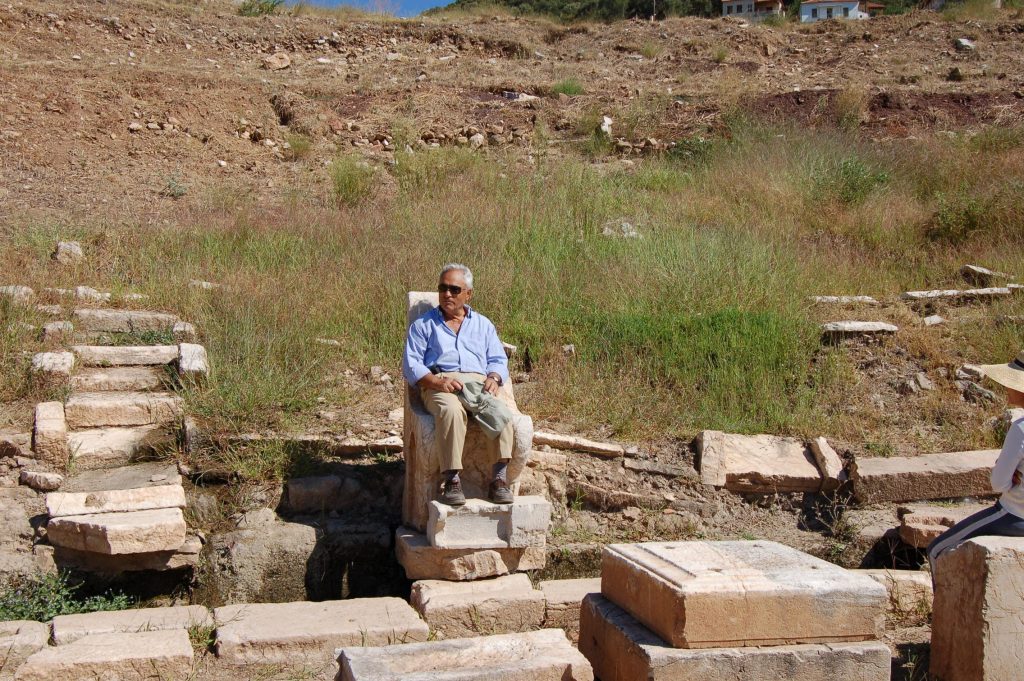
-It’s a place inextricably linked to Petros Themelis. Tell us about him…
Petros Themelis was the soul of Messini. He wasn’t just the director of a major archaeological site or project; he was the one who made Ancient Messene great, who built it up from scratch and gave it a prominent place on the world’s historical and cultural map. He was a man of absolute faith and dedication to his goal, with an unquenchable passion and love for our monuments and our culture. He pursued his vision as a tireless “worker” with strict discipline, organization, and methodical approach, displaying inexhaustible perseverance and patience in the face of all the difficulties and adversities he encountered. He was strict and demanding with his colleagues, yet at the same time open to the public, open to collaboration, and open to knowledge and sharing. With great generosity, he shared his thoughts, his experience, and his vision with us, making us his collaborators and co-creators of the cultural landscape he wanted to build. Through his personal example, he taught us the importance of dedication, collaboration, crisis management, and a love for what you do. A man who was both brilliant and humble—and, to me personally, fearless, even in the face of death.
It is difficult to fully assess the depth and breadth of his work. He left behind a vast body of work of inestimable value, both in the fields of archaeology and restoration and in the fields of management and administration, with a profound social, cultural, and economic impact, both for our region and for the entire country. A pioneer of his time on many issues concerning how antiquities and monuments were perceived and their relationship with the public and contemporary art.
He unquestionably laid the groundwork for the need to highlight, in-depth understanding, and socialization of monuments, emphasizing the benefits arising from the two-way relationship between the material remains of antiquity—not only with experts, but also with broader social groups.
For us, and for me personally, Petros Themelis is the “agathos daimon” of Messene, in the ancient Greek sense of the term “agathos,” who left an indelible mark, not only on the archaeological site but also within us.
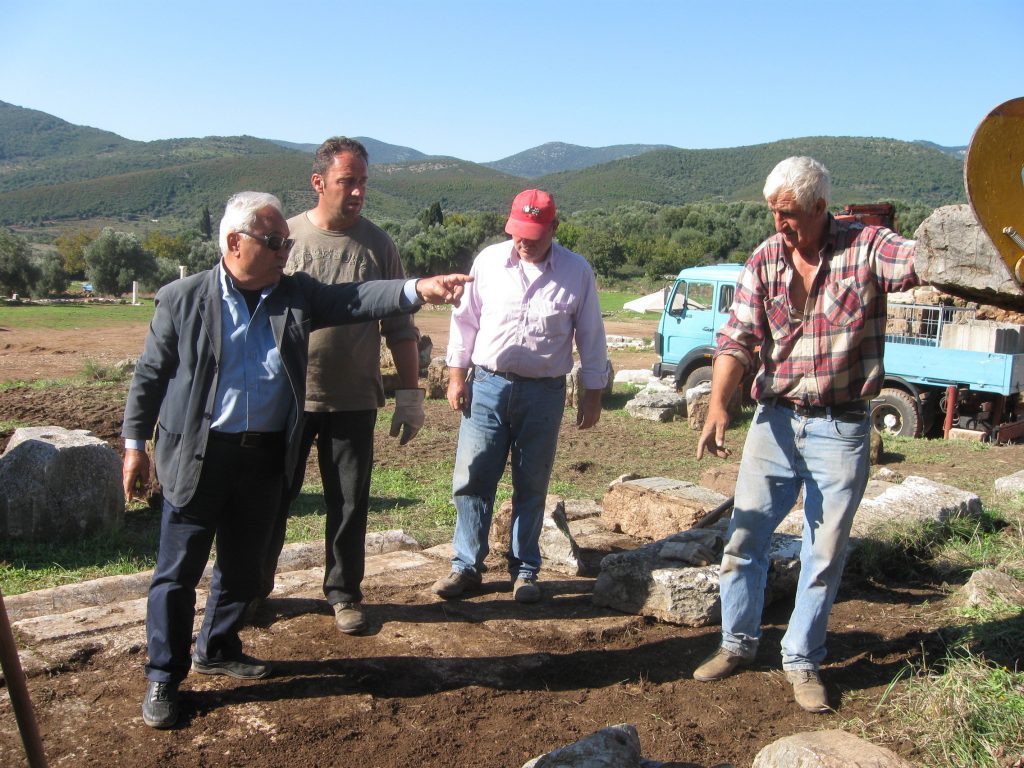
-When he passed away, were you afraid that the project he had planned would be left unfinished?
After his death, the truth is that there was a period of intense shock, a sense of emptiness and anxiety, but very quickly the response mechanism kicked in—the kind that emerges in times of danger—from people who truly loved the archaeological site, who recognized the professor’s great work and had supported him all these years.
Our sponsors—longtime steadfast supporters of the Messene project, specifically Mrs. F. Livanos and the I.F. Kostopoulos Foundation initially, but also many others who followed, such as the Captain Vasilis and Carmen Konstantakopoulos Foundation, the Athanasios Martinos Foundation (AIGEAS AMKE), and the G. and V. Karelia Foundation—to whom we extend our warmest thanks— have volunteered to continue supporting this work through the Society for Messinian Archaeological Studies (EMAS), the nonprofit organization founded by Professor P. Themelis in 1995 and continues to this day, through private donations, to support this major effort to showcase the most significant archaeological park in our country.
Crucial to this entire development was the support of the Ministry of Culture, and specifically that of the Minister of Culture, Lina Mendoni, who, recognizing the great work of EMAS, signed a Memorandum of Cooperation with the organization aimed at the care, preservation, promotion, and protection of the archaeological site of Messene.
At this time, therefore, EMAS plays a particularly active, decisive, and effective role in this regard and in achieving the objectives outlined in the aforementioned memorandum, with the result that the archaeological site today receives the care, protection, and use it deserves, exactly as its creator himself intended.
-You’ve taken over his position… What are your feelings, and how significant is this responsibility?
I have been president of the Society for Messinian Archaeological Studies since March 2024, and today, by decision of the Central Archaeological Council of the Ministry of Culture and Sports, I am co-director of the/research project at Ancient Messene, together with N. Kaltsas (secretary general of the Archaeological Society of Athens) and N. Tsivikis (a research fellow at the National Hellenic Research Foundation).
Both positions I currently hold carry, for me, a special moral, institutional, and emotional weight. They entail both great honor and an immense responsibility—first and foremost toward the broader realm of culture (as an archaeologist with the Ministry of Culture and Sports/Archaeological Service of Messinia), our history and our region, as well as specifically to the area of Messene, which I have served and continue to serve tirelessly and with absolute dedication for 25 years, but first and foremost to my teacher and mentor, Petros Themelis, to whom I owe a great deal— perhaps the greatest part, of my academic and personal growth, but also to all those people who trusted me and supported me after his passing. At the same time, I consider continuing and completing the project in Messene to be a major challenge. I believe that the foundations and all the necessary resources are in place; there is a plan and specific goals that will lead to the realization of this endeavor. We must—and we can—prove ourselves worthy of the expectations and the vision that was left unfinished, using him as our beacon and guide.
-He was a man with a vision and plans, and I’m sure you’re familiar with some of them. Are you continuing to follow the “guidelines” he gave you?
Certainly, the overall plan and vision for Messene are based on the professor’s principles and vision. The primary and main objective at this time is the completion of the project, both in terms of excavation and the restoration and presentation of the monuments that were not completed. At the same time, however, emphasis will be placed on publishing the research and the monuments along with their archaeological materials, so that Messene may become better known to both the academic community and the general public.
A fundamental prerequisite and objective for all of the above remains the conservation and care of this vast archaeological park, which requires ongoing efforts to clean, removal of overgrowth, and interventions at sites that are particularly vulnerable to the passage of time and weather conditions—an area in which we are already actively engaged.
At the same time, it is very important to enhance the visibility and promotion of Messene through events and performances of exceptional cultural and artistic value, thereby establishing it as a cultural hub and a catalyst for further development in the region and, by extension, for our country.
In this context, our Company, in collaboration with both the Athens Concert Hall and the Kalamata International Dance Festival, is moving in this direction, contributing in every possible way to the high-quality presentation and promotion of the archaeological site.
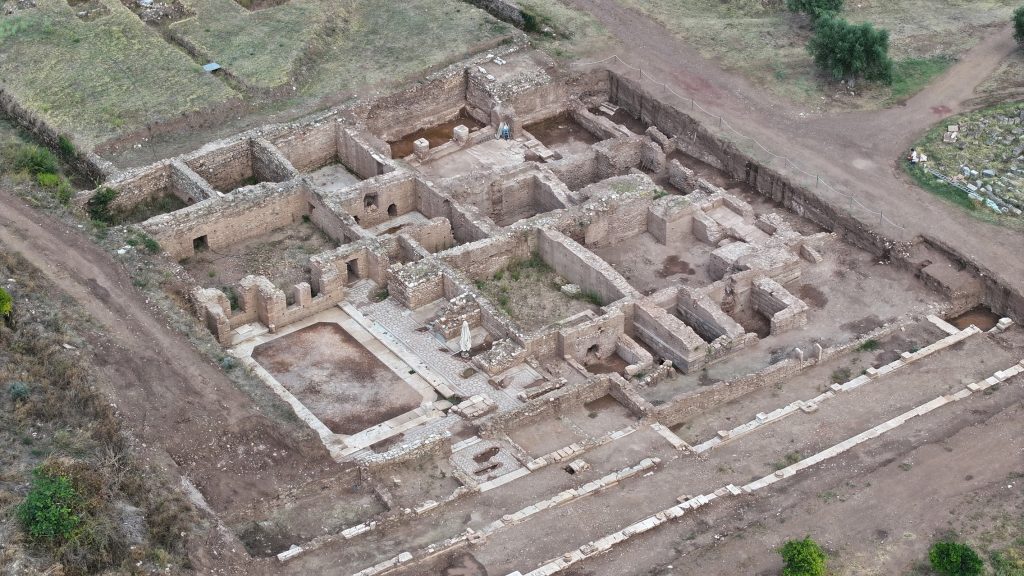
-When will the excavations resume, and what will you be focusing on?
Excavations will begin around mid-September and last for 4–5 weeks; this year, we will focus on the last major excavation project that was left unfinished, the site of the Great Roman Baths. We’ve prioritized the excavation at the Baths so that we can immediately proceed with conservation and stabilization work.
-This is a vast area, a small but impressive portion of which has been brought to light once again. If I asked you how far you want to go, what would you say?
According to the new five-year excavation and research program submitted to and approved by the Ministry of Culture, the focus will be on completing unfinished excavations and conservation work on monuments from all periods (from the Hellenistic to the Byzantine eras). These are primarily projects that Professor P. Themelis had begun together with his research team but was unable to complete.
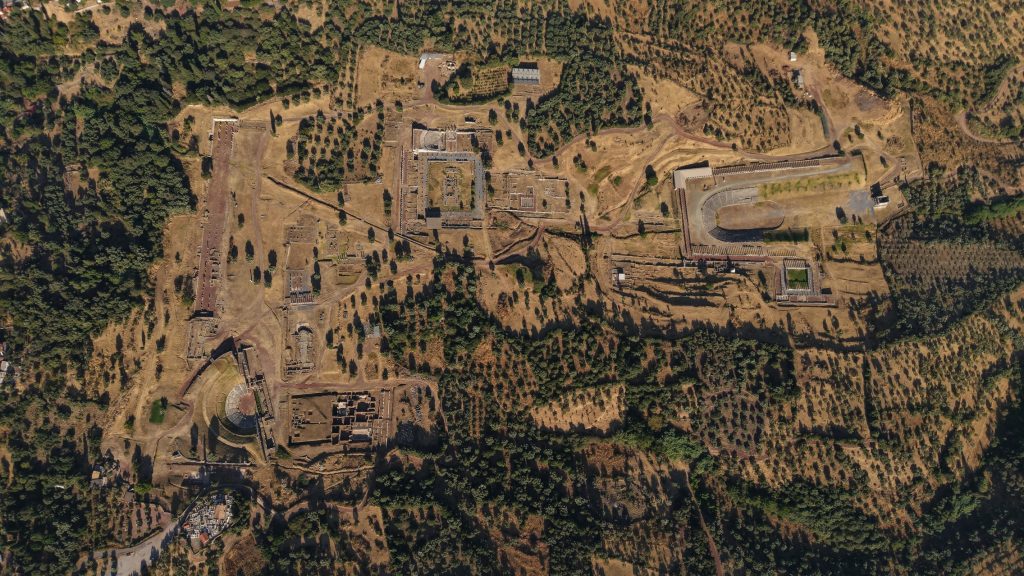
However, the ultimate goal and personal vision is the restoration and enhancement of the northern section of the archaeological site and its monuments, since the southern section—with the iconic Stadium-Gymnasium-Palestra complex has been fully restored, to the best of our ability, as dictated by the surviving original material.
EMAS will provide financial support through its sponsors, not only for the cleaning and maintenance of the archaeological site and the museum’s surrounding area, both the excavation/research and publication efforts as well as the restoration, reconstruction, and promotion of Messene—just as it has done all these years.
-Furthermore, the professor never minced words and often spoke out publicly. One of his most recent comments concerned the new museum, about which he held a different view. What is your view on this?
The professor always had his own way of speaking out publicly on issues and addressing events and situations that concerned him, regardless of the cost.
The issue the professor raised—namely, the preference for showcasing the monuments themselves as museums (in situ) rather than constructing new, centralized building complexes with high operating costs—touches on a central and enduring concern in contemporary museology and cultural heritage management.
Personally, I believe that both approaches have advantages and disadvantages. On the other hand, each archaeological site is unique and must be considered on its own merits.
In the case of Ancient Messene, I would advocate for a hybrid model. On the one hand, we have the creation of a large archaeological park with a large number of monuments, many of which have already been restored, which, with the necessary interventions, could house their finds—or some of them—offering an immersive experience incomparably superior to any enclosed museum.
The concept of a “park in motion” protects and enhances the landscape’s identity, connecting the past with the present in a vivid and evocative way. On the other hand, systematic archaeological research has brought—and continues to bring—to light thousands of movable artifacts, sculptures, and inscriptions.
The existing Archaeological Museum of Ancient Messene (the old Orlandos building in Mavrommati) is small and insufficient to house the enormous volume of treasures being discovered (there are now 20,000 movable artifacts alone), a fact that inevitably creates pressure for new storage and exhibition spaces, which the small “open-air monuments-museums” will not be sufficient to accommodate.
However, the key challenge and stake remains achieving the financial sustainability of the new museum—or “museums”— and how to ensure it, which will contribute to its smooth and uninterrupted operation with the lowest possible fixed costs, ideally, in my view, relying not only and exclusively on the state budget, but also on its own resources through a model of sound self-governance, always under the umbrella and supervision of the Ministry of Culture and Sports.
Your question, however, opens up a broad discussion on the issue of the financial sustainability of archaeological sites in general, an issue that had particularly concerned Professor P. Themelis in the past.
-Tell us about the profession of archaeology and your own career path…
P. Themelis has described the profession of archaeologist in a delightfully vivid and evocative way in his column “Archaeological Impressions,” providing a characteristic picture of an archaeologist’s daily life both in the field and in the office.
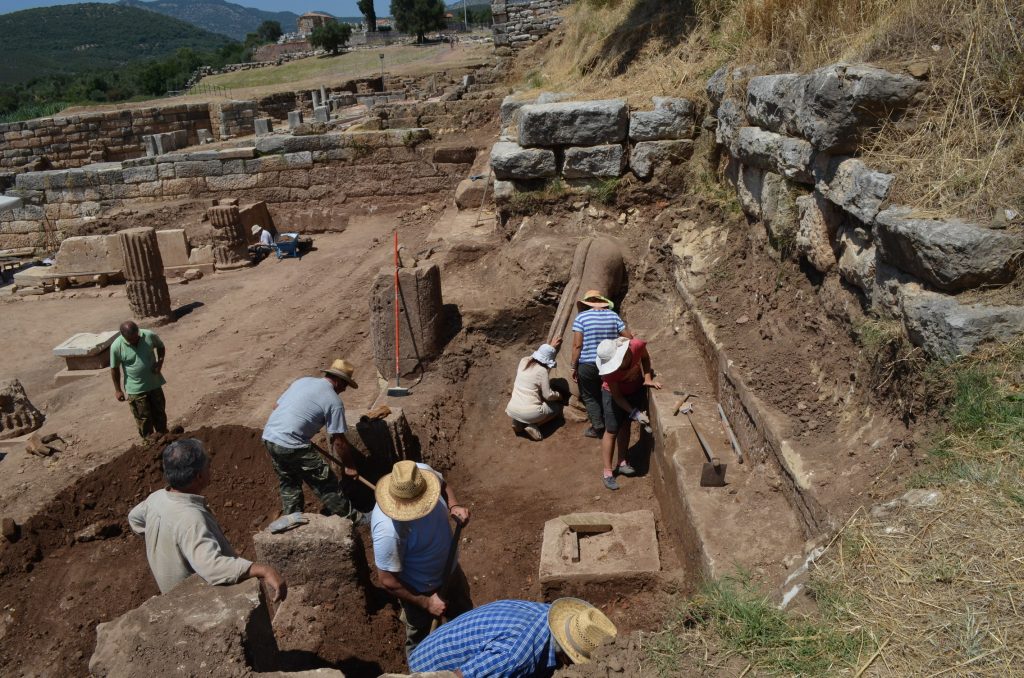
It is a tough and arduous job in the field, requiring resilience in the face of weather conditions, receptiveness, keen observation, patience, knowledge and a love of the subject, as well as many hours of dedication and commitment to study and scientific research in the office and in libraries.
To pursue archaeology, you must be able to feel the joy and excitement of discovering each new find, but at the same time endure the hardships of working under the scorching sun, be able to handle the demanding pace and challenging schedule both on-site and in the museum’s storage areas, and be able to work harmoniously with the entire team (archaeologists, surveyors, conservators, engineers, architects, and skilled laborers).
That is why it is so important for a student or a young person just starting out to have a mentor by their side from the very beginning—someone who is both open-minded and supportive, as I did—and as did many other colleagues and associates—with P. Themelis. A man who, when a mistake was made, did not punish but showed the right way through his own example, a teacher who threw you in at the deep end, trusted you, put you in positions of responsibility, but stood by your side during the tough times to keep things on track. A man who loved his students and teaching, who wasn’t afraid to share his knowledge with you, who truly wanted to see you progress and become a better archaeologist, a better person. He focused on us, on building our resilience and our self-belief, and he showed us that true success lies in how you react in difficult times. For me, my archaeological journey in Messene was a rite of passage into “real life,” which made me realize, among other things, that we all live within a system that we may not fully approve of, yet we are called upon—and must decide—each time just how far we are willing to compromise, and where and when we will take a stand. It is impossible to please everyone, but we must be useful; we must work for the common good.
-In recent years, especially in the humanities departments, we’ve seen prospective students turning their backs on these fields, resulting in low admission scores or even unfilled spots. How do you explain this?
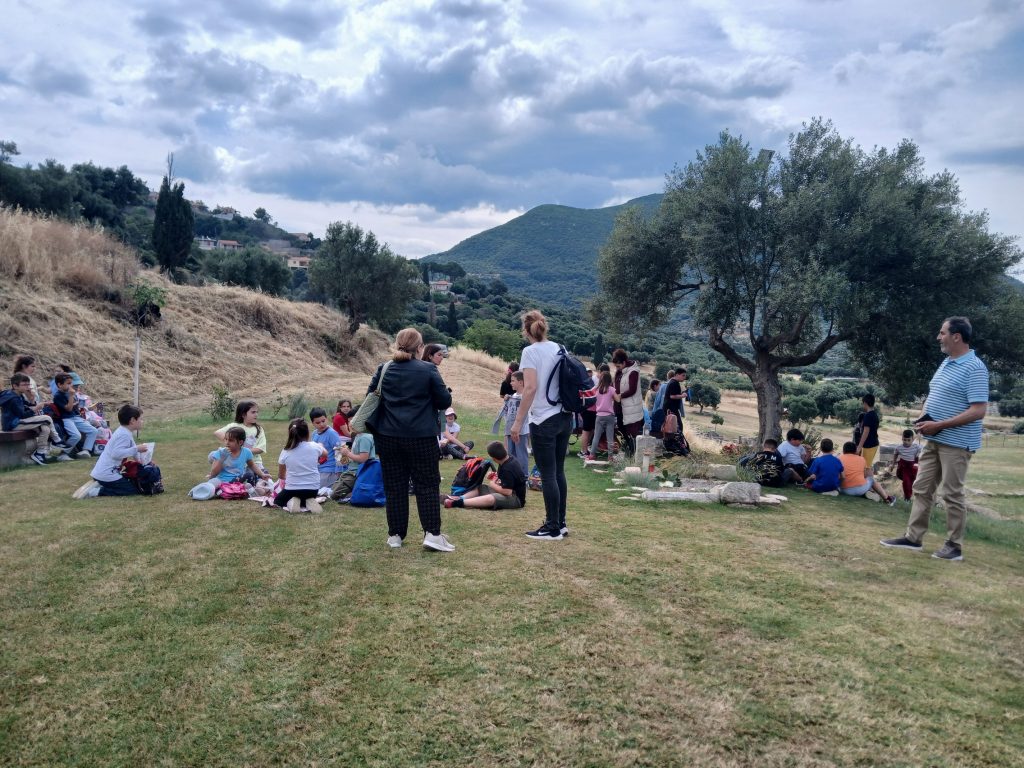
Globally, education is tending to align with the digital age and the market for information technology, artificial intelligence, and everything related to technology, engineering, and mathematics. Students, under pressure to secure a career, are turning to schools that promise faster or more lucrative job placement. In an era dominated by instant digital information and short attention spans, the academic discipline of archaeology seems “inaccessible” and anachronistic to a young person who lacks love, passion, and enthusiasm. At the same time, the decline in the status of classical studies in secondary education creates a vicious cycle. When these subjects are presented in schools in a dry and sterile manner, they cease to inspire the younger generation.
Humanities today, more than ever before, are considered absolutely essential because they serve as the necessary moral, critical, and existential counterweight in a technology-driven world, while at the same time providing a crucial complement to the natural sciences, teaching people how to analyze sources, identify biases, and avoid passively consuming any content. They provide the tools to understand the values, culture, and motivations of people and societies, while helping to preserve our cultural memory and identity.
For this reason, we must rethink the way we approach and present them.
By Panagiotis Babaroutsis