


Maria Tsioutsia, Study of Architectural Elements from the Sanctuary of Poseidon in Ancient Messene, Athens 2026, p. 133, ISBN 978-960-87555-6-7
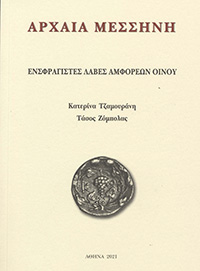
Katerina Tzamourani – Tasos Zomolas, ANCIENT MESSENE - SEALED HANDLES OF WINE AMPHORAS, Athens 2021, p. 111, ISBN 978-960-87555-5-0
This volume makes a substantial contribution to the study of the seals found on amphorae, which were imported into ancient Messene from renowned centers of production of top-quality wine, such as Rhodes, Cnidus, and Kos. The seals, which are usually found on the handles of the amphorae, bore the names of officials from the two islands and the coast of Asia Minor who were responsible for verifying the wine’s origin and guaranteeing its quality during the period from 146 to 30 B.BC. This high-quality wine was savored by the elected rulers of Messene as they “reclined” in their city’s banquet halls during festivals honoring deities such as Asclepius, Zeus Ithomatas, and others.
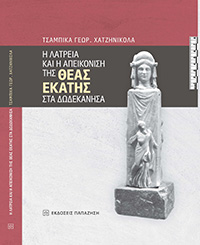
Tsambika, Georgios Hatzinikola, The Worship and Depiction of the Goddess Hecate in the Dodecanese, Athens 2019, p. 431, ISBN 978-960-02-3518-0
In this monograph, the author describes, classifies, and provides iconographic analysis of stylistically analyzes, and dates thirty-four images of Hecate from Rhodes and Kos, where a sanctuary dedicated to the goddess is also attested. The cult image of Hecate in the Dodecanese is not that of the dark goddess of the three-headed monsters, of nocturnal wanderings, of magical rituals, of the “untimely and violent deaths,” but rather a goddess who shares in the governance of the heavens, the sea, and the earth, gentle and benevolent, both helper and supporter of defenseless mortals in their daily struggle for survival.
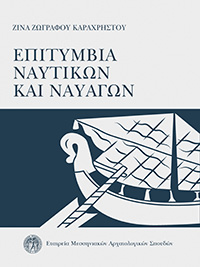
Zina Zografou Karachristou, Tombstones of Sailors and Shipwreck Victims (6th century B.C. – 3rd century A.D.), Athens 2018, p. 415, ISBN 978-960-87555-4-3
This comprehensive 415-page volume, which includes a catalog of more than 200 monuments, ninety-nine illustrations, and detailed commentary on the depictions and related inscriptions—followed by indexes and an extensive bibliography— the author sheds light in the best possible way on all aspects of the topic “funerary monuments of sailors and shipwreck victims,” the architectural form of the monuments, the varied depictions of ships, sailors, naval combatants, and shipwreck victims, as well as the literary and epigraphic evidence.

Petros Themelis, Maria Spathi, Kyriakos Psaroudakis (eds.), Sanctuaries and Cults of Messene from Antiquity to the Byzantine Period, Athens 2017, p. 297, ISBN 978-960-87555-3-6
Proceedings of the International Archaeological Conference held in October 2014 in Athens.
The archaeological material in this volume, the result of research conducted at ancient Messene over the past 30 years, fundamentally alters our understanding of the sanctuaries and cults of the capital of the Messenians. The volume includes thirteen original contributions by archaeologists, Byzantinists, and epigraphers, covering the subject matter and time frame of the conference.

Kaiti Dimitsantou-Kremezi, Neoclassical Architecture in Kalamata, Athens 2016, p. 158, ISBN 978-960-86016-3-5
The urban character of Kalamata between the late 19th and early 20th centuries was shaped by neoclassical architecture. Focusing on this significant phase in the history of the city’s modern architecture, the book presents the original hand-drawn line drawings of twenty-six buildings, which either display purely neoclassical characteristics or show influences from other modern artistic movements. The presentation of the architectural material is accompanied by historical data regarding the evolutionary course of Kalamata and the impact of these changes on both the economic and social levels.

Petros Themelis, The Past and the Present: Columns and Short Essays, Athens, 2015, p. 127
Articles by archaeologist Petros Themelis that were published as columns in the newspaper *Ta Nea* as well as in the daily press of Kalamata during the years 2004–2010. The first part of the book discusses aspects of our cultural past that touch on aspects of the present, while the second part addresses various topics related to the Middle Ages, modern Greek history, politics, and our political leaders.

Elisabeth P. Sioubara and Kyriakos Psaroudakis (eds.), THEMELION. 24 Studies on Professor Petros Themelis by His Students and Colleagues, Athens 2013, p. 483, ISBN 978-960-86016-2-8
Twenty-four scholarly studies, contributed by students and colleagues to Prof. Petros Themelis, in a commemorative volume honoring the archaeologist and scholar, a small token of appreciation for the Teacher. The studies cover topics related to ceramics, sculpture, architecture, epigraphy, numismatics, cult practices, and osteology.

Panos Valavanis (ed.), Traveling in Classical Greece. A Festschrift for Prof. P.G. Themelis, Athens 2011, p. 369, ISBN 978-960-86016-1-1
Twenty-one scholarly essays, a tribute from friends and colleagues to Professor P.G. Themelis in a volume honoring him as a person, an archaeologist, and a teacher. The studies cover the research fields of architecture, sculpture, ceramics, epigraphy, numismatics, and toruetics, as well as religious studies and history.

Petros Themelis (ed.), *Ancient Eleutherna: Sector I, vol. I*, Athens 2009, p. 235, ISBN 978-960-88394-9-6
It includes studies on ancient and Roman Eleutherna. A general introduction to Eleutherna and its history, with specific references to numismatic evidence, Greek and Latin inscriptions, as well as stamped Roman luxury pottery (terra sigillata), its production workshops, and its distribution.

Anastasia Yangaki, Pottery from Eleutherna, 4th–7th Centuries A.D., Athens 2005, p. 485, ISBN 960-88394-2-4
A comprehensive publication and study of Early Byzantine pottery from Eleftherna, Crete, which seeks to clarify issues of chronology and origin that remain unclear for Eastern Mediterranean pottery as a whole.

Petros Themelis (ed.), Early Byzantine Eleutherna: Section I, Athens 2004, Volume I, p. 277, ISBN 960-88394-0-8
It includes studies on the architectural and urban development of Early Byzantine Eleutherna, the tombs and grave goods, the gold amulets, the glazed pottery, and the bronze brooches.

Petros Themelis (ed.), Early Byzantine Eleutherna: Volume I, Rethymno 2000, Volume II, p. 319, ISBN 960-85468-9-3
It includes studies on the Early Byzantine pottery of Eleutherna and its potters, technological observations on the pottery, Early Byzantine inscriptions, numismatic finds, and a paleopathological study of the population.

Chryssi Bourbou, The People of Early Byzantine Eleutherna and Messene (6th-7th cent. A.D.): A Bioarchaeological Approach, Αθήνα 2004, σελ. 123, ISBN 960-88394-1-6
An anthropological study of the skeletal remains of the population of Early Byzantine Eleutherna, examining the diseases as well as the living conditions and hygiene that contributed to the residents’ health status.

Moritz Kiderlen, Petros Themelis (eds.), The Poseidon Sanctuary at Akovitika in Messenia: Structure and Developmental Context of a Regional Center, Wiesbaden 2010, p. 254 (+ 6 fold-out diagrams), ISBN 978-3895-0072-86
A large-format, hardcover volume containing a complete publication of the archaeological finds and artifacts, along with historical conclusions from the excavation of the Sanctuary of Poseidon at Akovitika. It contains studies on geology, architecture, ceramics, micropaleontology, and epigraphy.

Petros Themelis, Voula Konti (eds.), Early Byzantine Messene and Olympia: Urban and Rural Space in the Western Peloponnese, Proceedings of the International Symposium, Athens, May 29–30, 1998, Athens, 2002, p. 286, ISBN 960-87389-0-3
Proceedings of a symposium featuring studies on the early Byzantine Peloponnese, the city of Messene, and the sanctuary at Olympia. Studies on pottery, urban planning, numismatics, and funerary inscriptions.

Abel Blouet, *Scientific Expedition to Morea: Messene*, Paris 1831; Reprint of the chapter on Messene, Athens 1997, p. 35, ISBN 960-86016-0-6
A facsimile of the chapter on ancient Messene from the historical and particularly rare edition by Abel Blouet.

Petros Themelis, Rodoula Stathaki-Koumaris (eds.), Galaxidi from Antiquity to the Present, Proceedings of the Galaxidi Scientific Conference, September 29–30, 2000, Athens 2003, p. 221, pl. 80, ISBN 960-87765-0-3
Conference proceedings that include studies on Galaxidi from antiquity and the Byzantine era through to modern times. Special mention is made of issues related to shipbuilding and the construction of bows.

Petros Themelis (ed.), Glass from Antiquity to the Present, Proceedings of the International Conference held in Margarites, Mylopotamos, September 26–28, 1997, Athens 2002, p. 245, ISBN 960-87555-0-6
It includes a large number of studies on the use, development, and manufacturing techniques of glass from prehistoric times to the present day.

Helen Saradi, The Byzantine City in the Sixth Century: Literary Images and Historical Reality, Athens 2006, 543 pages with 65 figures, 62 plans in the text, 20 plans in appendix, ISBN 960-87555-1-4
A significant contribution to our understanding of the Early Byzantine city and the way its inhabitants themselves perceived it. An interdisciplinary approach to the study of the Early Byzantine city, which takes into account virtually all known sources and archaeological data.
Our publications are available at the offices of the Society for Messenian Archaeological Studies (33 Psaromiligkou, 10553, Athens, Kerameikos, tel. 210 3314324) and at select bookstores:
MIET https://mietbookstore.gr/
POLITEIA https://www.politeianet.gr/
ANDROMEDA BOOKS https://www.andromedabooks.gr/
IANOS https://www.ianos.gr/